By Toxirium Team | Updated: January 2026 | Estimated Reading Time: 25 Minutes
Quick Summary: How to Achieve a Perfect Reptile Temperature Gradient
Achieving a scientifically correct reptile temperature gradient is the biological foundation of herpetoculture. Here are the 5 essential steps for success:
-
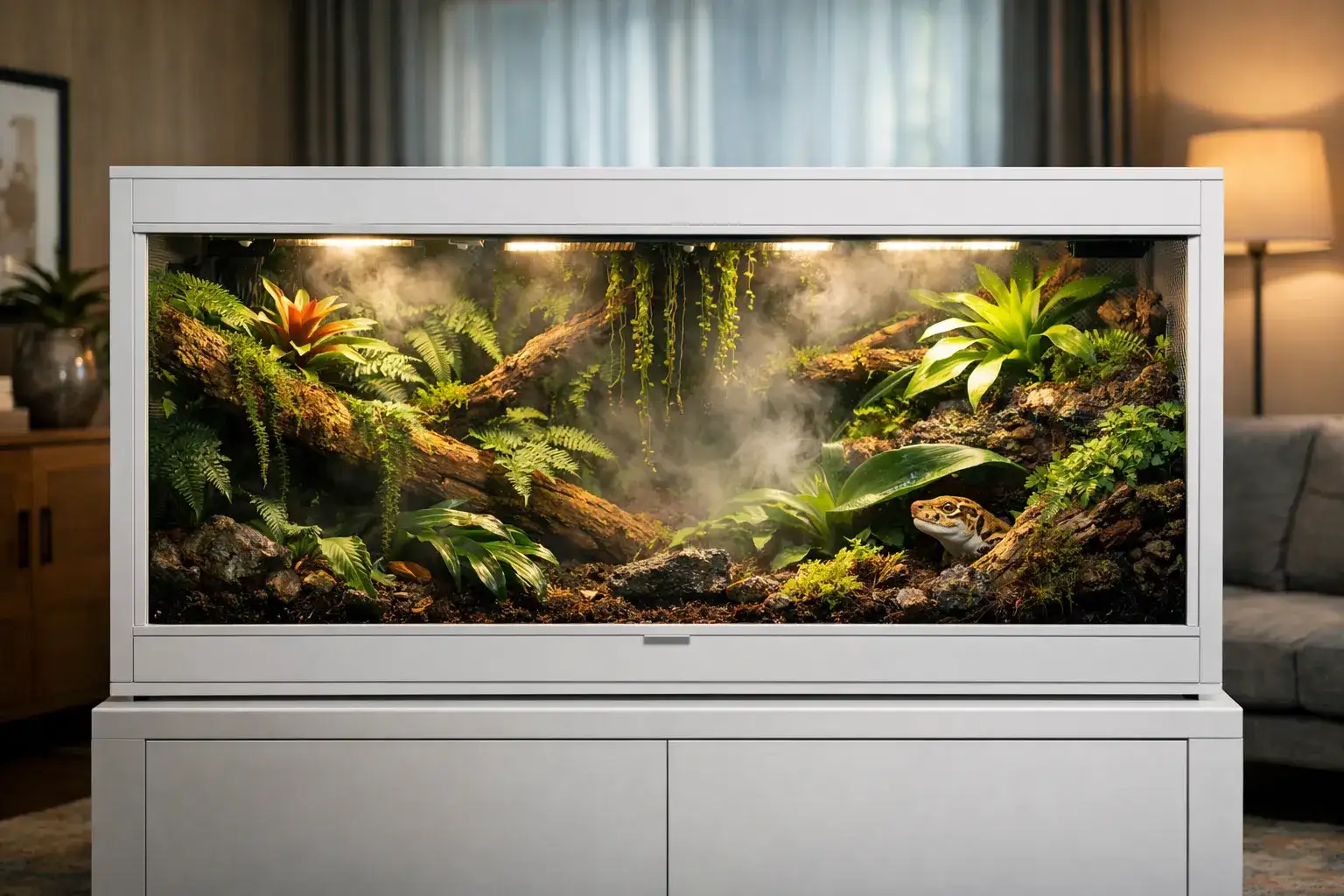
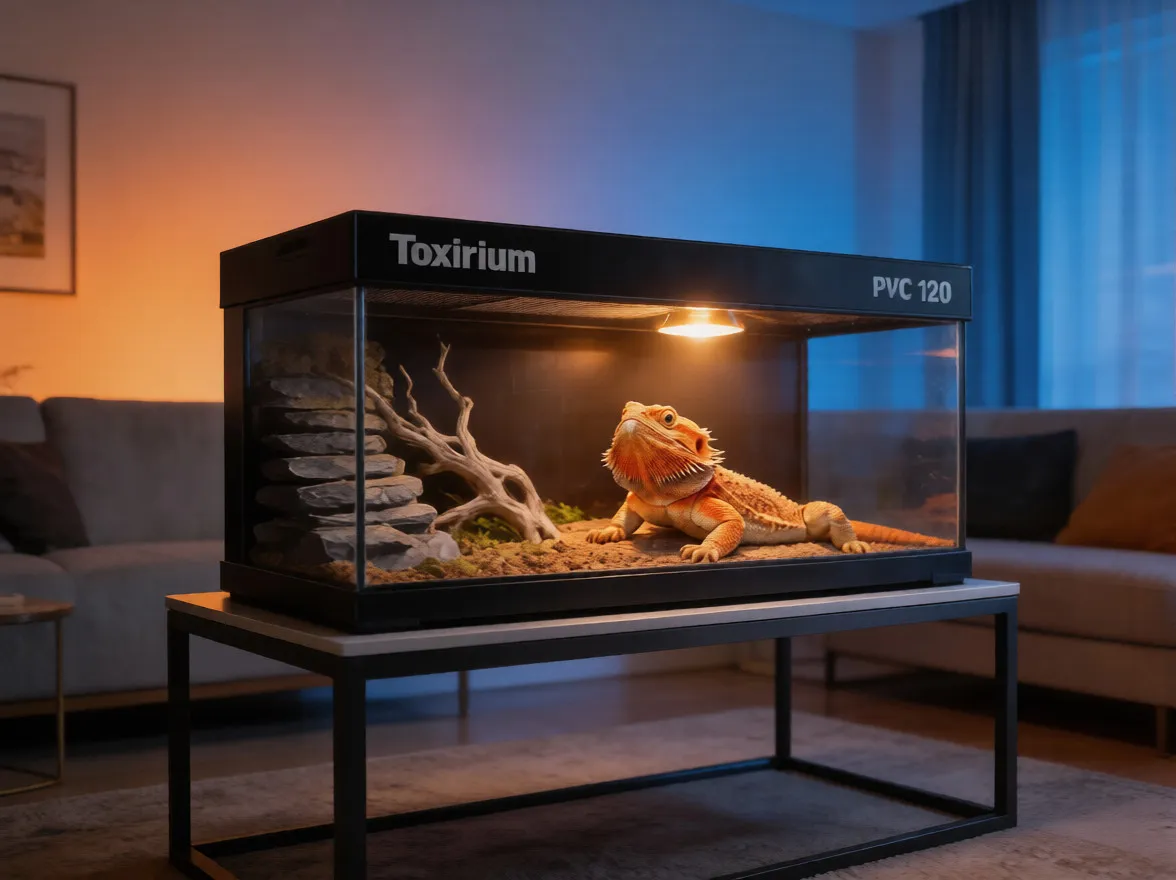
Maximize Linear Distance: Use a minimum 120-gallon (4’x2’x2′) enclosure to allow infrared heat to dissipate properly over distance.
-
Insulate the “Box”: Choose PVC material over glass to trap IR-A energy in the basking zone while keeping the cool side stable.
-
Optimize Heat Source: Use a Halogen Flood Bulb (Infrared-A) mounted on the far ceiling side.
-
Precision Control: Connect the heat source to a Dimming Thermostat to prevent overheating and oscillation.
-
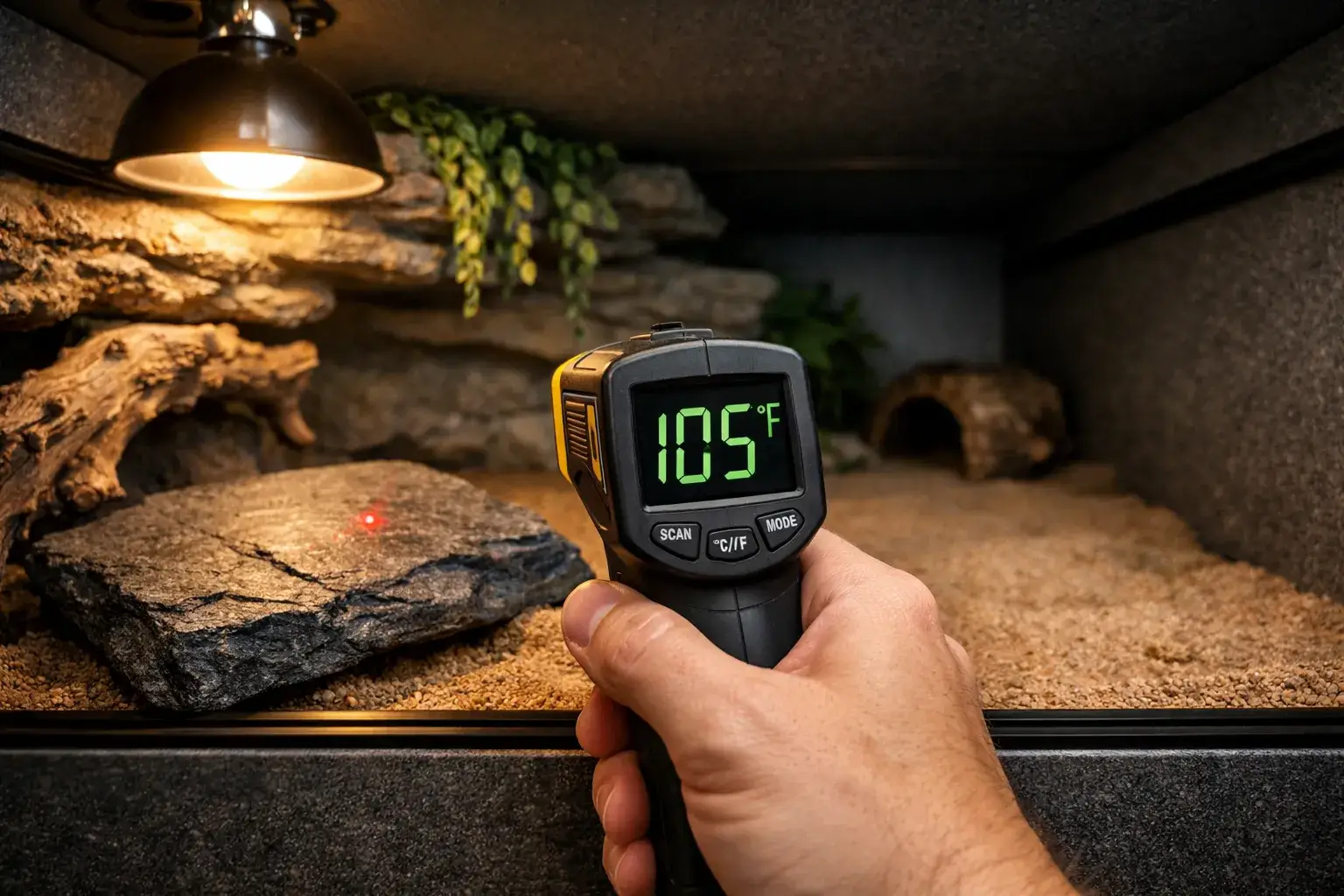
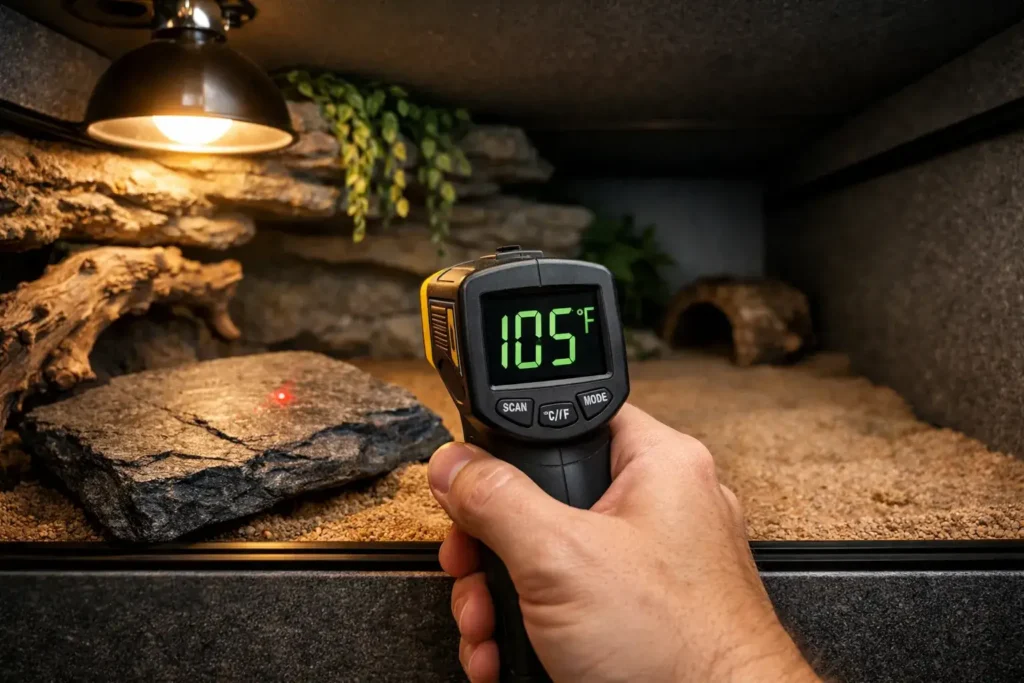
Verify Zones: Use an Infrared Temp Gun to measure the surface zones of your reptile temperature gradient.
Introduction: The “Sauna vs. Freezer” Reality
Imagine wearing a heavy winter coat inside a sauna. Now, imagine standing naked in a walk-in freezer. Neither situation is comfortable. But for you, your body would shiver to warm up or sweat to cool down.
Now, imagine you cannot shiver and you cannot sweat.
This is the silent reality for countless reptiles living in captivity today. As ectotherms (cold-blooded animals), they rely entirely on the external reptile temperature gradient to regulate their metabolism.
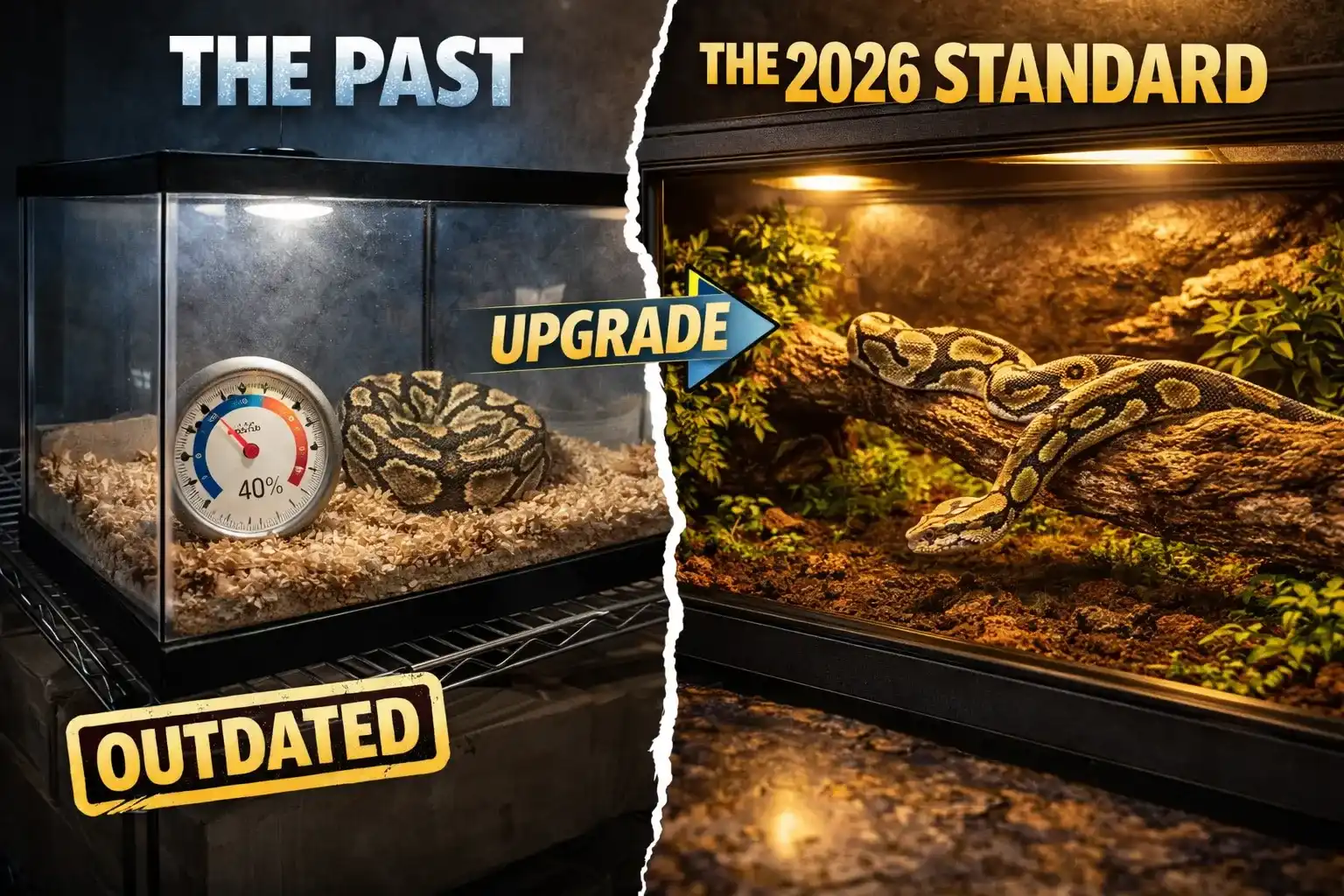
However, achieving a perfect reptile temperature gradient—where one side is scorching hot (105°F+) and the other is pleasantly cool (75°F)—is the single hardest challenge in husbandry. Most keepers fail because they use glass tanks that bleed heat, creating a uniform, stagnant temperature soup.
Many keepers mistakenly believe that keeping a tank “generally warm” is enough. It is not. Without a precise cool zone, a reptile’s metabolism burns out, leading to organ failure. Without a precise hot zone (specifically Infrared-A), food rots in their stomach.
In this 2026 Masterclass, we move beyond basic “hot side/cool side” advice. We will explore the hard science of Infrared Physics, the thermodynamics of PVC vs. Glass, and exactly how to set up your enclosure to master the reptile temperature gradient for the long-term health of your animal.
Phase 1: The Biology – Why “Close Enough” Kills
Why do we need such precision? Can’t the room just be “warm”? No. A failing reptile temperature gradient has devastating biological consequences.
1. The Enzyme Activation Energy
Reptile digestion is not just mechanical; it is a chemical reaction powered by heat.
-
The Science: Digestive enzymes (like pepsin) in reptiles have a specific “activation energy.” If the reptile temperature gradient does not offer a basking zone of 95°F-105°F (depending on species), these enzymes simply do not work.
-
The Consequence: Food sits in the stomach and rots (regurgitation) instead of digesting. The animal may eat, but it is starving nutritionally.
-
The Immune System: Similarly, white blood cell production is heat-dependent. A reptile without access to the high end of a reptile temperature gradient is essentially immunocompromised and prone to infections.
2. The “Cool Down” Necessity
Conversely, reptiles cannot sustain high heat indefinitely. This is where small tanks fail.
-
Metabolic Burnout: If a Bearded Dragon stays at 100°F constantly (because the tank is too small or made of glass), their metabolism runs in overdrive. They burn fat reserves too fast, leading to kidney strain and a shortened lifespan.
-
The Neuro-Protective State: The “Cool Side” (75°F – 80°F) allows the brain and organs to rest. Without a broad reptile temperature gradient that includes a true cool zone, there is no biological rest.
Phase 2: The Physics of Heat (Infrared Spectrum)
In 2026, professional keepers don’t just talk about “heat.” We talk about Wavelengths. Not all heat is created equal. To achieve a functional reptile temperature gradient, you must understand the sun.
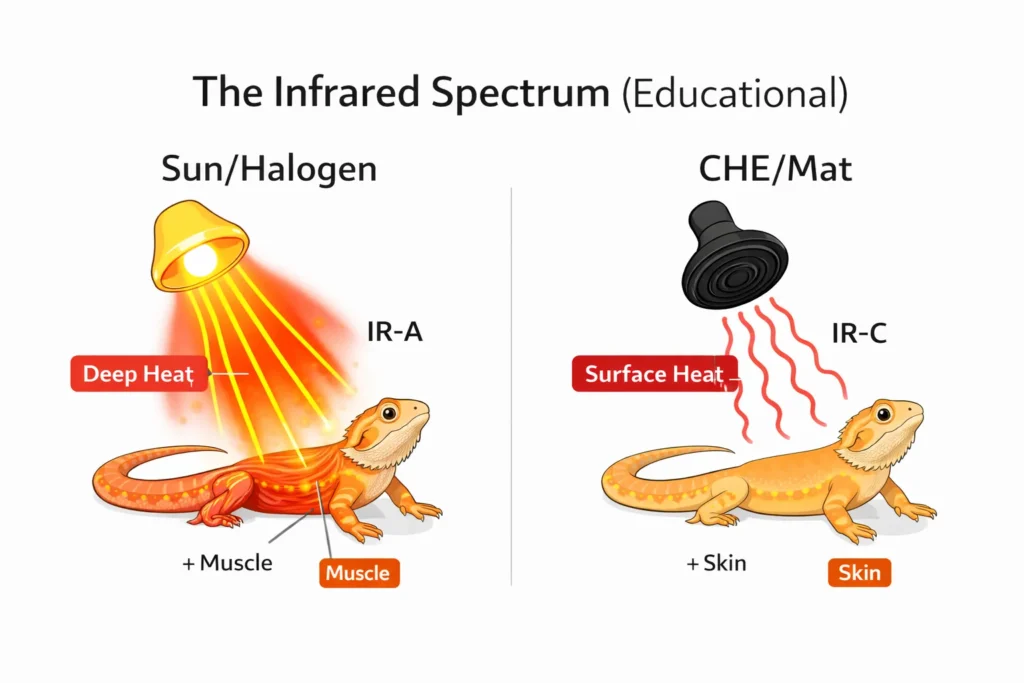
1. Infrared-A (IR-A): “Deep Heat”
-
Source: The Sun, Halogen Flood Bulbs (PAR38).
-
Effect: Short wavelength, high energy. It penetrates deep into the reptile’s muscle tissue and bone. This is the heat they crave for basking. It warms them “from the inside out,” increasing circulation.
-
Role in Gradient: IR-A creates the high surface temperature peak essential for a proper reptile temperature gradient.
2. Infrared-B (IR-B): “Dermis Heat”
-
Source: Deep Heat Projectors (DHP).
-
Effect: Penetrates the skin layer but not as deep as IR-A. It is excellent for nocturnal heating or supplemental warming.
3. Infrared-C (IR-C): “Ambient Heat”
-
Source: Ceramic Heat Emitters (CHE), Heat Mats, Radiant Heat Panels (RHP).
-
Effect: Long wavelength. It only warms the surface of the skin and the air. It does not penetrate muscle.
-
Role in Gradient: Used to boost ambient air temperature in the background, but cannot replace a basking bulb.
The Common Mistake: Many keepers use a CHE (IR-C) as their main heat source. The snake feels warm on the skin but is cold inside its core. They will stay under the heat for hours, dehydrated, trying to get warm but failing. A true reptile temperature gradient must start with IR-A.
Phase 3: The Thermodynamics of Material – Glass vs. PVC
You can have the best bulbs in the world, but if your “box” is broken, your reptile temperature gradient will fail. This is a battle of Thermal Conductivity.
1. Glass: The “Thermal Sieve”
Glass has extremely high thermal conductivity. It transfers heat energy rapidly from inside to outside.
-
The Scenario: You put a 100w bulb in a 40-gallon glass tank. The heat radiates out through the thin glass walls into your living room.
-
The Result: To keep the hot side hot, you use a massive, high-wattage bulb. But because the tank is small (36 inches) and glass doesn’t insulate, the heat bleeds over to the cool side. The whole tank becomes a uniform 90°F soup. Reptile temperature gradient = Failed.
2. PVC: The “Insulator”
Toxirium PVC has extremely low thermal conductivity. It acts like a cooler.
-
The Scenario: You put a 75w Halogen in a Black 4’x2’x2′ PVC Enclosure. The PVC walls trap the IR-A energy inside the basking zone.
-
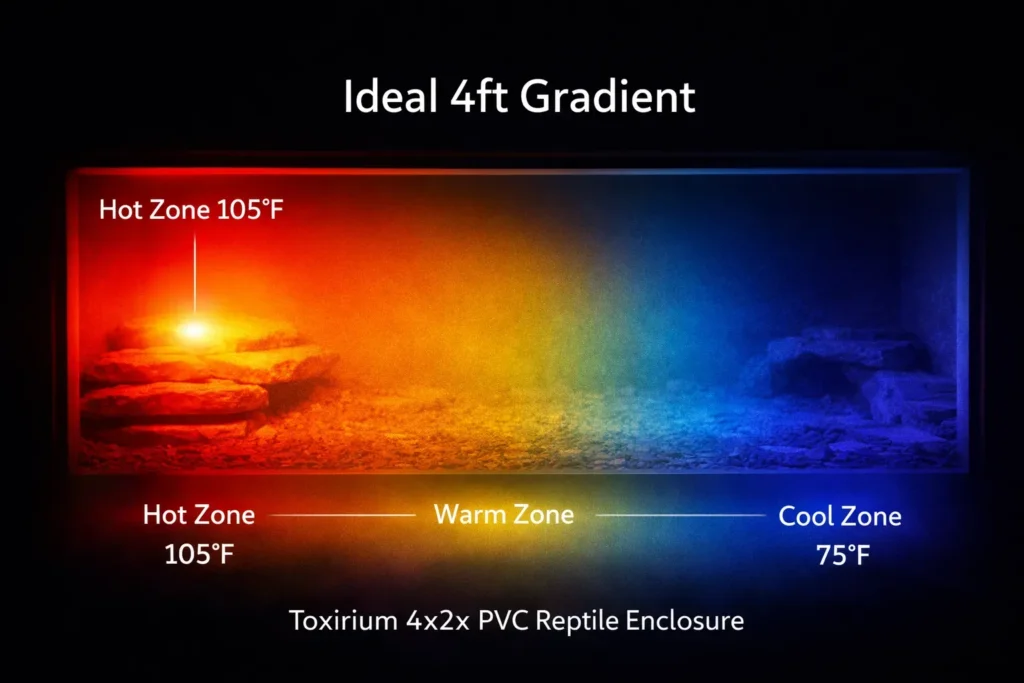
The “Heat Shadow”: Because PVC insulates so well, the heat stays where you put it. It doesn’t bleed laterally. This allows the other side of the 4-foot cage to stay naturally cool.
-
The Result: A sharp, defined reptile temperature gradient. 105°F on the left, 75°F on the right.
Phase 4: Step-by-Step Setup for the Perfect Reptile Temperature Gradient
Here is the “Toxirium Protocol” for setting up your heat zones in a 120-gallon (4x2x2) enclosure.
Step 1: The “Far Side” Rule
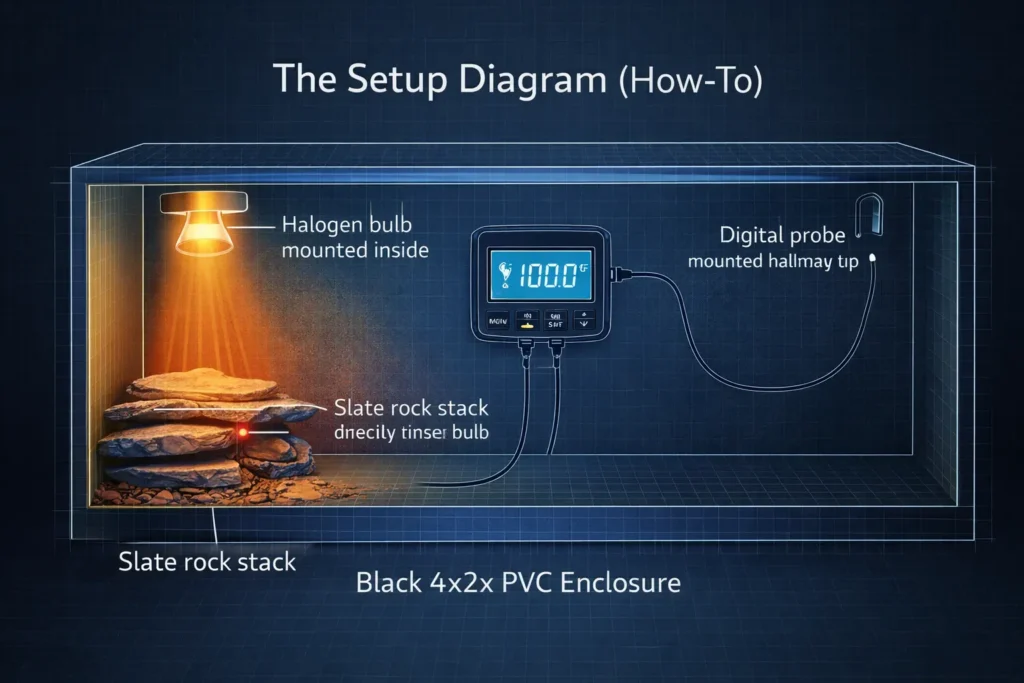
Mount your heat source (Halogen Flood) as far to one side as possible—literally 6 inches from the side wall.
-
Why? If you mount the light in the center, heat radiates both ways, destroying your cool zone. By pushing it to the edge, you maximize the linear distance (4 feet) for the reptile temperature gradient to drop off naturally.
Step 2: The Basking Stack (Conduction)
Place a stack of dark slate, brick, or river rock directly under the heat lamp.
-
Physics: Dark stone has high Thermal Mass. It absorbs IR-A and re-radiates it upwards as IR-C (belly heat).
-
Height: Build the stack up so the top rock is 12-15 inches from the bulb. This ensures the “Surface Temp” is high without the “Air Temp” becoming suffocating.
Step 3: Ventilation Tuning
Toxirium PVC Enclosures feature strategic side and rear vents.
-
Hot Side Vents: Allow excess hot air to escape (Chimney Effect), preventing the “oven effect.”
-
Cool Side Vents: Draw in fresh, cooler room air to maintain the low end of the reptile temperature gradient.
-
Glass Tank Failure: Top-screen glass tanks lose ALL heat and humidity. PVC vents control it.
Step 4: Supplemental Heating (The “Hybrid” Method)
This step is crucial for cold climates.
If your room is freezing (below 65°F), a single Halogen bulb might not be enough to keep the cool side at 75°F.
-
The Fix: Install a Radiant Heat Panel (RHP) or a low-wattage Deep Heat Projector (DHP) in the middle of the cage.
-
The Setting: Set this secondary source to a low thermostat temperature (e.g., 78°F). This bumps up the background ambient heat without ruining the peak basking zone, preserving your reptile temperature gradient.
Phase 5: The Control Center – Thermostats
You cannot achieve a stable reptile temperature gradient with a simple “On/Off” switch.
The “Dimming” Thermostat
For Halogen bulbs (IR-A), you must use a Dimming Thermostat (like Herpstat or Vivarium Electronics).
-
How it works: Instead of turning the bulb off (which creates a disco strobe effect), it restricts the electricity flow. The bulb glows dimmer or brighter to maintain a laser-precise 105°F.
-
Why it matters: This keeps the “beam” of heat constant. The animal doesn’t experience “hot/cold/hot/cold” cycles, which promotes better digestion.
Probe Placement Strategy
-
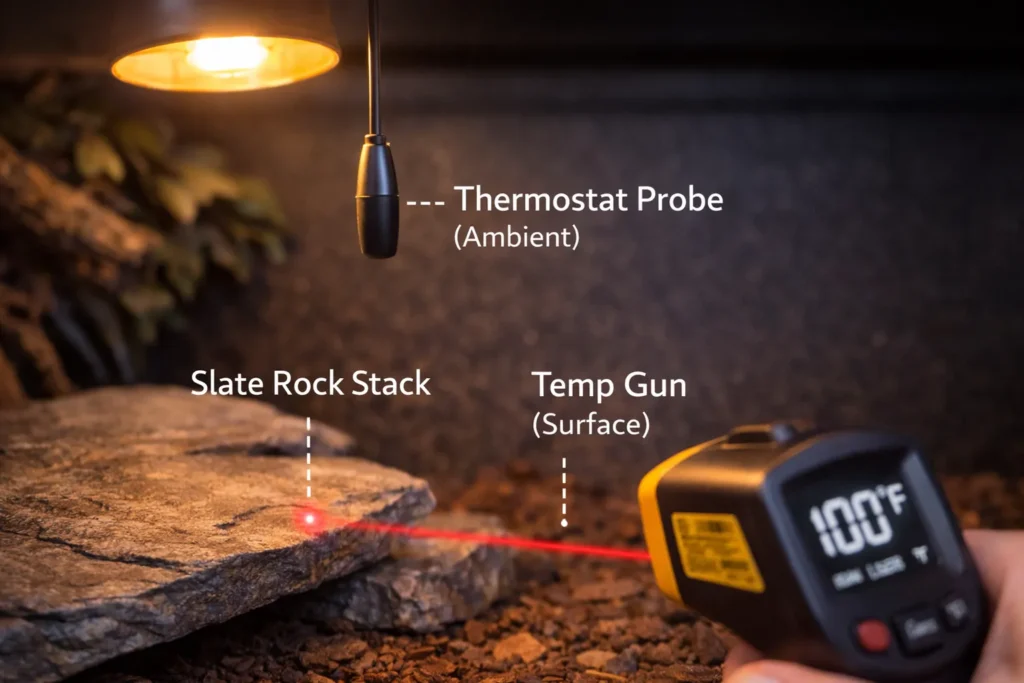
Safety Probe: Place the thermostat probe about 2-3 inches under the heat lamp, hanging in the air. Set the thermostat to a temperature that results in the correct surface temp on the rock (you will need to experiment).
-
Do not: Glue the probe to the rock (the lizard will sit on it and block the reading, causing the heater to spike and burn the animal).
Phase 6: Measuring – Gun vs. Probe
You need two different tools to verify your reptile temperature gradient. One tells you what the air feels like; the other tells you what the sun feels like.
1. The Infrared Temp Gun (Surface Temp)
-
What it measures: The temperature of the solid object (slate rock).
-
Target: 105°F – 110°F (for Bearded Dragons); 90°F (for Ball Pythons).
-
Usage: Point the laser directly at the rock under the lamp. This verifies the peak of your reptile temperature gradient.
2. Digital Probes (Ambient Air Temp)
-
What it measures: The temperature of the air the animal breathes.
-
Placement: You need TWO probes.
-
One mounted on the Cool Side wall (Target: 75°F – 80°F).
-
One mounted on the Warm Side wall (Target: 85°F – 90°F).
-
-
The Delta: If the difference between your two probes is less than 10°F, your reptile temperature gradient is failing. You likely need a longer cage (4ft+) or better ventilation.
Phase 7: Troubleshooting Your Reptile Temperature Gradient
Scenario A: “My Cool Side is Too Hot”
-
Diagnosis: This is the most common issue in glass tanks or enclosures smaller than 4 feet. The heat has nowhere to go.
-
The Fix:
-
Upgrade to a 120 Gallon (4x2x2) PVC Enclosure. The length is the only cure.
-
Lower the wattage of your bulb.
-
Check if your room temperature is too high (>80°F).
-
Scenario B: “My Basking Spot is Hot, but Air is Cold”
-
Diagnosis: Common in screen-top cages or drafty rooms where heat escapes upwards.
-
The Fix:
-
Upgrade to PVC (insulation keeps the warm air inside).
-
Add a secondary IR-C heat source (CHE) in the middle of the cage to boost the ambient baseline of your reptile temperature gradient.
-
Frequently Asked Questions (FAQ)
Q: Why is my cool side temperature too high?
A: This is the most common problem when trying to establish a reptile temperature gradient in glass tanks or enclosures smaller than 4 feet. Heat disperses like gas; if the box is too small, the “Hot Side” bleeds over. To fix this, you must upgrade to a 120-gallon (4ft long) enclosure to give the heat enough distance to dissipate.
Q: Where should I place the thermostat probe?
A: Do not place it on the basking rock (the animal will sit on it and block the reading). For a dimming thermostat controlling a basking bulb, let the probe dangle about 2-3 inches below the bulb. Use a separate digital thermometer gun to verify the surface temperature of the rock.
Q: Can I use a Heat Mat for a gradient?
A: No. Heat mats produce IR-C (contact heat). They do not warm the air, meaning they cannot create an “ambient reptile temperature gradient.” They only create a warm spot on the floor. For a true gradient, you need an overhead heat source like a Halogen or DHP.
Q: What is the difference between Surface Temp and Ambient Temp?
A:
-
-
Surface Temp: The heat of the object (rock) measured with an Infrared Gun. This should be high (105°F+) for digestion.
-
Ambient Temp: The heat of the air measured with a Digital Probe. This should be lower. Managing both is key to a stable reptile temperature gradient.
-
Conclusion: The “4-Foot” Rule
Achieving a perfect reptile temperature gradient is not about luck; it is about physics.
You cannot force a gradient into a small box. Physics requires distance for heat to dissipate. This is why the 4x2x2 (120 Gallon) size is not just a luxury; it is a biological necessity for thermoregulation.
By combining the insulating properties of Toxirium PVC, the distance of a 4-foot enclosure, and the precision of Halogen/Dimming tech, you are not just keeping a reptile; you are empowering an ecosystem.
Stop fighting the thermodynamics of glass.
Master the gradient with the right tools.
Shop the Toxirium 4x2x2 PVC Enclosure Series
Engineered for Thermoregulation. Use code TR8OFF for 8% OFF.